
Six months. PKR 600,000 spent. Zero customers.
Imagine paying a marketing agency every month and getting a glossy report in return: thousands of impressions, hundreds of new followers, a bright green arrow pointing up. But your phone isn’t ringing. Your inbox is empty. When you ask who’s actually buying, the answer is a vague “it takes time.” When you ask for access to your own ad account, you’re told it’s “handled internally.” And when you finally ask to leave, you find out the contract runs for six more months.
A digital marketing agency red flag is any warning sign, in a pitch, contract or report, that an agency may waste your budget or hold your business back. Bad agencies rarely hide it well. The signs show up in the first call, the proposal or the first monthly report. This guide covers 15 of them, why each matters, and what to do about it, then ends with a checklist for your next sales call.
Red flags vs. green flags at a glance
| Area | Red flag | Green flag |
| Promises | Guaranteed #1 rankings | Clear deliverables and honest timelines |
| Accounts | Agency owns your accounts | You own everything, agency is a user |
| Reporting | Impressions and likes | Leads, sales, cost per acquisition, revenue |
| Contract | 12 months with exit penalties | 3 months or monthly rolling terms |
| Pricing | Vague, hidden fees | Itemized, ad spend separate |
| Proof | “Big brands” with no names | Specific case studies and references |
| Onboarding | Pitches before asking questions | Asks about customers, goals and margins |
1. They guarantee #1 rankings or specific results
In short: A guaranteed ranking or result is the biggest red flag, because no agency controls Google.
Why it matters: Google’s own hiring guidance says no one can guarantee a #1 ranking, because results depend on hundreds of factors no agency controls, including competitors and algorithm updates.
What to do: Ask what they can commit to: deliverables, reporting frequency, response times and clear goals. Honest agencies promise effort and transparency, not outcomes they can’t control.
2. They won’t explain their strategy
In short: A good agency can explain its strategy in plain language.
Why it matters: If the answer to “how will you do this?” is “that’s our secret sauce,” you can’t judge the work or learn from it. Good agencies happily explain what they’ll do, in what order, and why.
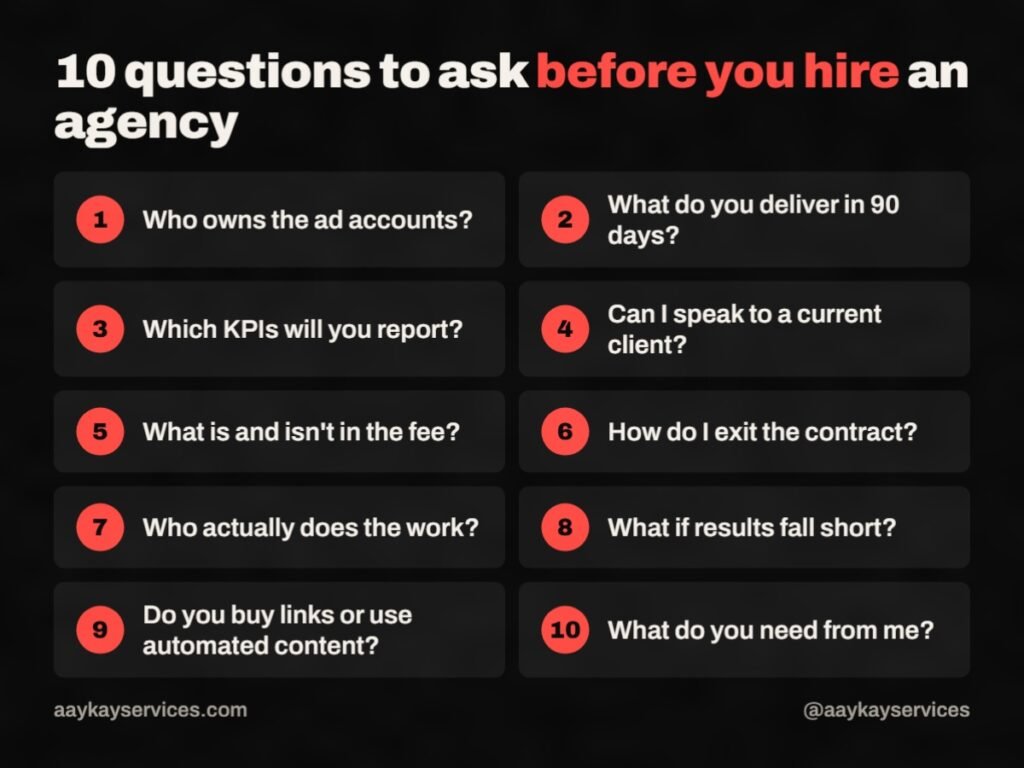
What to do: Ask them to walk you through the first 90 days in plain language.
3. They keep control of your accounts
In short: You should own your ad accounts, analytics and website, with admin access.
Why it matters: Your Google Ads, Google Analytics, Search Console, Meta ad account, domain and website should be in your name. If everything sits under the agency’s accounts, you’re renting your own marketing and can lose your data if you leave.
What to do: Ask on day one: “Who owns the accounts, and will I have admin access?” The answer should be you, and yes.
4. They report vanity metrics
In short: Reports should lead with leads, sales and revenue, not impressions and likes.
Why it matters: Impressions, likes and followers feel good but don’t pay your bills. If reports lead with those numbers and bury leads, sales, cost per lead or revenue, the agency is dodging accountability.
What to do: Agree on 3 to 5 business KPIs before work starts, such as qualified leads, cost per acquisition and revenue by channel.
5. Their reports are confusing on purpose
In short: A good report is understandable without a marketing degree.
Why it matters: A report full of jargon and screenshots, with no explanation of what changed and why, hides more than it shows.
What to do: Ask for a one-page monthly summary: what we did, what happened, what it means, what’s next.
6. They run the same playbook for everyone
In short: A proposal should be tailored to your business, not a template.
Why it matters: A local restaurant, a SaaS startup and an online store need very different strategies. If your proposal looks like a template with your logo swapped in, it probably is. A related sign is an agency that pushes one channel (only ads, or only SEO) to every client.
What to do: Look for proposals that mention your competitors, audience and goals by name.
7. They lock you into a long contract
In short: Long lock-in contracts with exit penalties favor the agency, not you.
Why it matters: A 12-month contract with a heavy exit penalty before you’ve seen results protects the agency, not you. Marketing takes time, but good agencies earn renewals.
What to do: Ask for a 3-month starting term or monthly rolling terms with 30 days’ notice, and read the termination clause before signing.
8. The pricing is vague or full of hidden fees
In short: Pricing should be written down, itemized, and separate ad spend from fees.
Why it matters: Watch for surprise “setup,” “platform” or “management” fees, and tools billed separately. Unclear pricing makes it impossible to compare agencies or check value.
What to do: Request a written breakdown that separates agency fees from ad spend. Ad budget should go to the ad platform, not disappear into the retainer.
9. The price is suspiciously low
In short: Very low prices often mean templated work or hidden costs later.
Why it matters: Quality marketing takes skilled people and time. An unusually cheap offer often means templated work, junior staff, outsourced shortcuts or a bait-and-switch later.
What to do: Compare scope, not just price. Ask who will do the work and how many hours you’re getting.
10. They can’t show real proof
In short: Real agencies show specific case studies and references.
Why it matters: No case studies, no named clients, no references, or only vague claims like “we’ve worked with big brands.” Real results are specific: the problem, what was done, what changed.
What to do: Ask for two or three case studies similar to your business and a reference you can call.
11. Their own marketing is weak
In short: An agency’s own marketing is a preview of what it can do for you.
Why it matters: An agency that can’t rank, post consistently or run a decent website is asking you to trust them with something they haven’t managed for themselves.
What to do: Check their website speed, blog, social profiles, reviews and Google Business Profile before booking a call.
12. They don’t ask you questions
In short: A good agency asks many questions about your business before proposing anything.
Why it matters: A good agency interrogates you about your customers, margins, sales process, competitors and goals. If they jump straight to pitching services, they’re selling, not strategizing.
What to do: Count the questions they ask on the first call. If it’s close to zero, that’s your answer.
13. They use shady tactics
In short: Paid links, fake reviews and “special Google access” claims put your site at risk.
Why it matters: Buying links, private blog networks, fake reviews, keyword stuffing, or claiming a “special relationship” with Google can get your site penalized, and the damage can outlast the contract.
What to do: Ask directly: “Do you buy backlinks or use automated content?” Any dodge is a no.
14. They’re reactive, with no clear plan
In short: A good agency brings a written plan and proactive ideas.
Why it matters: If they only respond when you complain and never bring new ideas, tests or insights, you’re paying for a ticket system instead of a growth partner.
What to do: Ask for a written 90-day plan with milestones and review it at every meeting.
15. Communication is slow and the team keeps changing
In short: Slow replies and constant team changes signal an unstable agency.
Why it matters: Slow replies, missed calls and a new account manager every few months usually signal an overloaded or unstable agency.
What to do: Agree on response times and a single point of contact before you start.
Frequently asked questions
What is the biggest red flag in a digital marketing agency?
A guarantee of top rankings or specific results. Nobody controls Google’s algorithm, so an honest agency can promise work, reporting and transparency, but not a position. Other major red flags are no access to your own accounts, vague reporting and long lock-in contracts.
How do I know if my digital marketing agency is bad?
Check four things: do you own your accounts, do reports show leads and revenue, can they explain what they did last month and why, and do they bring new ideas without being asked? If two or more answers are no, ask for a review meeting.
How long should it take to know if a marketing agency is working?
Paid ads can show early signals within weeks, while SEO and content usually take a few months to build. From week one, though, you should see a clear plan, honest reporting and fast communication.
Is it a red flag if an agency won’t give me account access?
Yes. Your ad accounts, analytics, domain and website are business assets. You should hold admin-level ownership, with the agency added as a user, so you can leave without losing data or history.
How much does a digital marketing agency cost?
Pricing varies widely by scope, industry and location. Instead of comparing monthly fees, compare what is included, who does the work, and whether ad spend is billed separately from agency fees.
Can I leave a digital marketing agency mid-contract?
It depends on the termination clause. Many contracts include notice periods or early-exit fees, so read that clause before signing and negotiate a short initial term or monthly rolling agreement.
Final thoughts
The right agency acts like a partner: transparent, curious about your business and honest about what’s possible. If you spot two or three of these flags, ask questions. If you spot five or more, keep looking.
At AayKay Services, a remote digital services agency, work with clear scopes, honest timelines and reporting you can actually understand. Want a second opinion on a proposal you’ve received? Contact us at aaykayservices.com and we’ll take a look.


Leave a Reply