
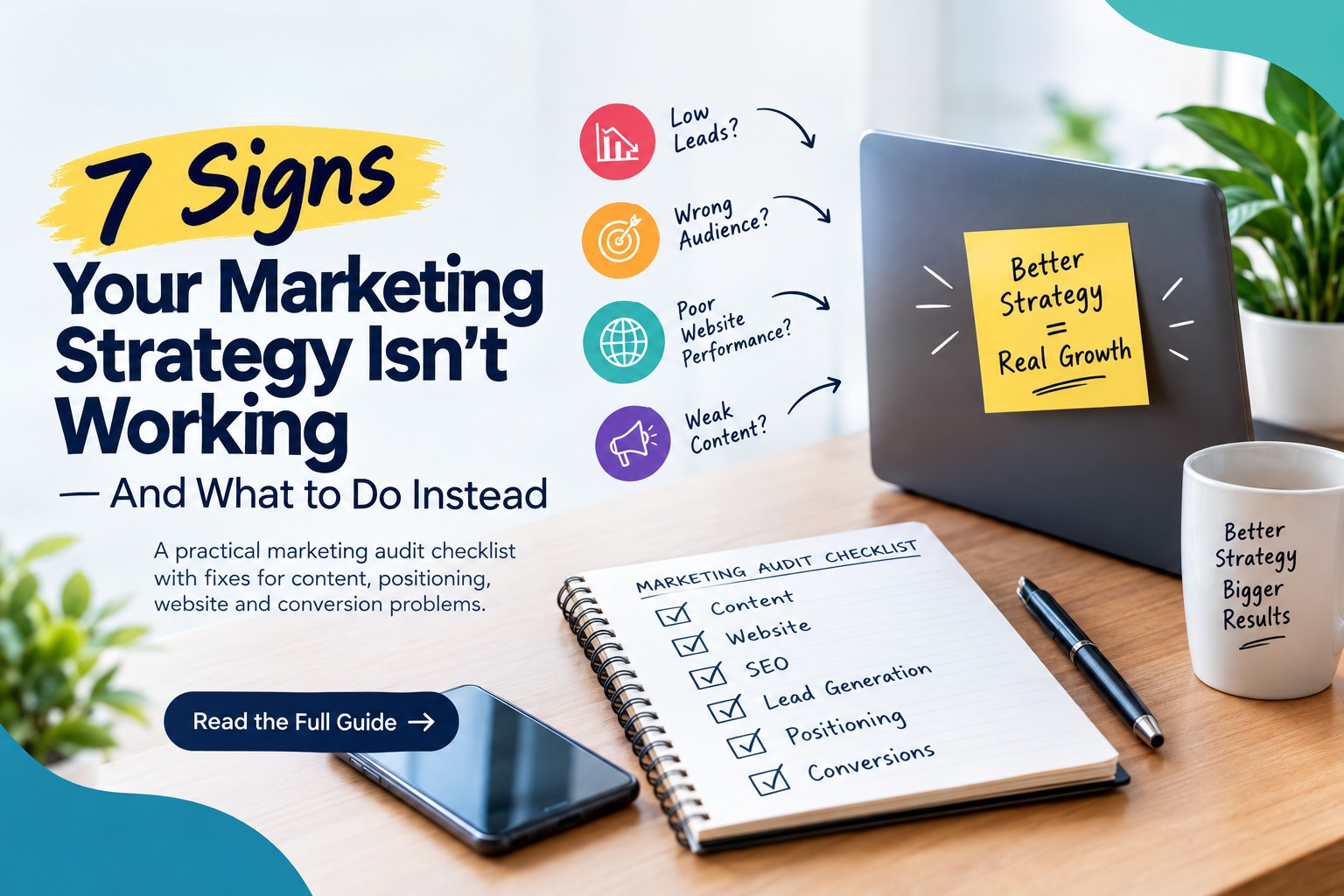
Signs Your Marketing Strategy Isn’t Working can be easy to miss when your business is constantly busy with content, social media, SEO, email campaigns, and advertising. You may be posting every week and getting website traffic, but still wonder why enquiries and sales are not growing. The problem may not be a lack of marketing activity. Your strategy may simply need a closer look.
A marketing strategy audit can help you find the gaps between what your business is doing and what your customers actually need. From weak content and unclear positioning to poor website conversions and low-quality leads, here are seven common warning signs and practical ways to fix them.
Your Content Gets Attention but No Action
One of the first signs your marketing strategy isn’t working is when you are creating plenty of content but getting very little from it. You may be publishing blog posts, social media updates, videos, newsletters, and promotional content regularly. Your team is staying active, but people are not clicking, enquiring, signing up, or buying.
The problem may not be how often you publish. It could be that your content does not have a clear purpose.
Good content should do more than fill your social media calendar. It should answer questions, solve problems, build trust, explain your services, or guide people towards the next step.
What should you do instead?
Look through your recent content and ask:
- Who is this content for?
- What problem does it solve?
- Does it answer a question customers actually ask?
- Does it support one of our business goals?
- Is there a clear next step?
A strong content strategy connects your content to your audience and your wider business goals.
Explore our Content & Copywriting Services
Your Website Gets Visitors but Doesn’t Generate Leads
Getting visitors to your website helps, but traffic alone doesn’t guarantee business growth.
If people visit your website and leave without contacting you, booking a call, requesting a quote, or taking another valuable action, your website may be the problem.
This is another important sign that your marketing strategy needs attention.
There are many possible reasons. Your homepage may not explain your offer quickly enough. Your service pages may be difficult to understand. Your CTA may be hard to find. Your website may also be slow, confusing, or difficult to use on mobile devices.
What should you do instead?
Look at your website as if you were visiting it for the first time.
Within a few seconds, can someone understand:
- What do you offer?
- Who do you help?
- Why should they choose you?
- What should they do next?
Your homepage and service pages should answer these questions clearly.
Make your important CTAs easy to find and remove unnecessary steps from your contact or enquiry process.
Improve Your Website Management
You’re Getting Leads, But They’re the Wrong Leads
More enquiries do not always mean better marketing.
You might receive plenty of messages, but many could come from people who are looking for a cheaper service, want something you do not offer, or are simply not the right fit for your business.
This usually points to a problem with your targeting, positioning, or messaging. A successful lead generation strategy should attract people who are genuinely interested in what your business offers.
What should you do instead?
Review your recent leads and look for patterns.
Ask yourself:
- Where did your best leads come from?
- Which leads became paying customers?
- Which services attracted the strongest prospects?
- Which enquiries were a poor fit?
- What problems were your best customers trying to solve?
Use these answers to refine your audience and marketing message.
Your goal should not be to reach everyone. Your goal should be to reach the people who are most likely to need and value your services.
Strengthen Your Digital Marketing
Your Marketing Message Keeps Changing
Another common sign of a weak marketing strategy is inconsistent messaging. One campaign may focus on low prices. Another talks about premium quality. Your website may focus on one benefit while your social media promotes something completely different.
Customers should not have to work out what your business actually stands for. Consistency does not mean using exactly the same words everywhere. It means maintaining the same core message across your website, social media, content, emails, and advertising.
What should you do instead?
Start with four simple questions:
- Who do we help?
- What problem do we solve?
- How do we solve it?
- Why should customers choose us?
Your answers should guide your marketing.
Your campaigns can have different topics and creative styles, but the main value you offer should remain clear.
A clear message makes it easier for the right customer to understand why your business is relevant to them.
Build Clearer Content & Messaging
You’re Measuring Likes Instead of Business Results
Likes, followers, impressions, and views can be useful numbers, but they do not tell the whole story. A post could receive thousands of views without generating a single useful enquiry.
This is one of the biggest problems a digital marketing audit can uncover. Businesses sometimes focus on numbers that are easy to see instead of numbers that show whether marketing is actually helping the business.
What should you measure instead?
Depending on your goals, pay attention to metrics such as:
- Qualified leads
- Website enquiries
- Conversion rate
- Organic traffic
- Email sign ups
- Cost per lead
- Sales
- Customer acquisition cost
- Returning customers
You do not need to track every number available.
Choose the metrics that help you understand whether your marketing is contributing to real business growth.
Explore Our SEO Solutions
Your SEO and Content Strategy Are Working Separately
SEO and content should not operate in two separate worlds.
You might be publishing useful articles that nobody finds in search. At the same time, you might be targeting keywords that have little connection to your customers or services. When SEO and content work together, your website can attract people who are already searching for answers related to your business.
What should you do instead?
Start by identifying the questions and problems your customers regularly search for.
Then build useful content around those topics and connect that content with relevant services.
For example, instead of creating a broad article about marketing, you could create content around specific customer problems such as:
- How to improve website conversions
- Signs your marketing strategy isn’t working
- How to create a content strategy
- How to improve lead generation
- When to conduct a marketing strategy audit
This approach gives every piece of content a clearer purpose.
Your content should help the reader first while also supporting your SEO and business goals.
Get SEO Support for Your Business
You’re Doing More Marketing Instead of Better Marketing
Perhaps the biggest of all signs your marketing strategy isn’t working is the feeling that the answer is simply to do more.
- More social media posts.
- More ads.
- More emails.
- More platforms.
- More campaigns.
But adding more activity will not necessarily solve a strategy problem.
If your messaging is unclear, your website is difficult to use, or you are targeting the wrong audience, doing more of the same can simply increase the amount of wasted time and money.
What should you do instead?
Stop and review the complete customer journey.
Look at:
- Your website
- SEO
- Content
- Social media
- Brand positioning
- Lead generation
- Conversion process
- Email marketing
- Analytics
- Customer experience
Then identify the biggest problem.
You do not have to fix everything at once. Start with the issue that is creating the biggest barrier between your business and your customers.
Start With a Marketing Strategy Audit
One-Page Marketing Audit Checklist
Use this simple checklist to identify where your marketing needs attention.
Content Strategy | Website | SEO | |
1 | Does every important piece of content have a purpose? | Can visitors understand our offer quickly? | Are we targeting relevant keywords? |
2 | Are we answering real customer questions? | Are our main service pages easy to find? | Does our content match search intent? |
3 | Does our content connect with our services? | Is the website mobile friendly? | Are our important service pages optimized? |
4 | Are we updating old or underperforming content? | Is the website easy to navigate? | Are we monitoring organic traffic and rankings? |
Lead Generation | Positioning | Performance | |
1 | Are we attracting the right audience? | Is our main message clear? | Are we tracking conversions? |
2 | Do we know where our best leads come from? | Do we clearly explain who we help? | Do we know which channels generate leads? |
3 | Is there a clear path from visitor to enquiry? | Is our value easy to understand? | Are we measuring more than likes and followers? |
4 | Are we following up with leads? | Is our messaging consistent? | Do we regularly review marketing performance? |
If you answered “No” to several questions, it may be time for a marketing strategy audit.
What Should You Fix First?
When several areas of your marketing need improvement, trying to fix everything at once can become overwhelming.
Instead, find the biggest problem first.
For example, if your website gets plenty of visitors but very few enquiries, improving your conversion process may be more valuable than publishing another 20 blog posts. If you are attracting lots of traffic but the wrong audience, review your targeting and positioning.
If your content receives attention but does not support your services, revisit your content strategy. If your leads are inconsistent, examine your lead generation strategy and the channels bringing those leads to your business. The important thing is to understand the connection between each part of your marketing.
- Content attracts attention.
- Your website builds trust.
- Your offer creates interest.
- Your conversion process makes taking action easier.
When these pieces work together, your marketing has a much stronger foundation.
How Often Should You Conduct a Marketing Strategy Audit?
You do not need to completely change your marketing strategy every month. However, regular reviews can help you catch problems before they become expensive.
A detailed audit can be useful when:
- Website traffic starts falling
- Leads suddenly decrease
- Advertising costs increase
- Content engagement drops
- Your target audience changes
- You launch a new service
- Competitors start gaining ground
- You redesign your website
- Your business goals change
You can perform smaller monthly reviews while conducting a deeper marketing strategy audit every few months. The goal is not to constantly change direction. It is to make sure your marketing still matches your customers, market, and business goals.
Frequently Asked Questions
- What are the signs your marketing strategy isn’t working?
Some of the most common signs your marketing strategy isn’t working include declining leads, low website conversions, poor quality enquiries, inconsistent messaging, weak content performance, and marketing activity that creates attention without generating meaningful business results.
- What is a marketing strategy audit?
A marketing strategy audit is a structured review of your marketing activities. It can include your website, SEO, content, social media, positioning, lead generation, conversion process, and performance data. The purpose is to identify what is working and where improvements are needed.
- How often should I conduct a digital marketing audit?
A smaller performance review can be done regularly, while a more detailed digital marketing audit can be carried out every few months or whenever there is a major change in your business, audience, website, or marketing results.
- Why is my website getting traffic but no leads?
Website traffic does not automatically produce enquiries. Your website may have unclear messaging, weak CTAs, poor page structure, slow loading times, limited trust signals, or an offer that does not match what visitors are looking for.
- How can I improve my lead generation strategy?
Start by identifying your ideal audience and the problems they need to solve. Then choose the right marketing channels, create useful content, improve your website’s conversion process, and track which sources generate qualified leads.
Final Thoughts
The signs your marketing strategy isn’t working are not always obvious. Sometimes the problem is not a lack of effort. You may simply be putting effort into the wrong areas. A practical marketing review can show whether your biggest problem is content, SEO, positioning, your website, conversions, or lead generation.
Before increasing your budget or adding another marketing channel, take a step back and look at what is already happening. Better marketing does not always mean doing more. Sometimes it means fixing what is already there.
Find the gaps. Fix what matters. Build a marketing strategy that works.
Comments
One response to “Signs Your Marketing Strategy Isn’t Working: 7 Key Warning Signs”
A good piece to read about the importance of getting not only traffic but turning them into leads… 🙌🏻